 Qorrect Blog

In the modern education system, the true or false question format remains a practical way to measure students’ understanding of concepts quickly and clearly. When designed carefully, the true or false question format can support formative assessment, reinforce information, and reveal common misconceptions.
Qorrect platform provides a package of tools and educational services for creating, delivering, and analyzing digital assessments. By using Qorrect, professors can organize the true or false question format within structured exams, review student performance, and use assessment data to improve teaching strategies and learning outcomes.
Universities are also looking for digital solutions that make assessment faster, reliable, and easier to manage.
Book a free demo from Qorrect platform
Table of Contents
What Is a True or False Question Format?
The true or false question format is one of the simplest assessment methods used to evaluate whether students can identify accurate information and distinguish it from incorrect statements. In this type of exam, students are presented with a clear statement and asked to determine whether it is true or false based on their knowledge and understanding of the subject.
The true or false question format is particularly useful when professors need to assess factual knowledge, basic concepts, definitions, principles, or students’ ability to recognize common misconceptions. Although these questions are simple in structure, effective design is essential to ensure that they measure learning rather than guessing ability.
A well-designed true or false question format should contain statements that are clear, specific, and directly related to the intended learning outcomes. Professors should also avoid ambiguous wording, unnecessary complexity, or statements that may have more than one interpretation.
When implemented assessment through Qorrect platform, the true or false test format becomes easier to create, organize, deliver, and evaluate. Qorrect platform can support professors in managing electronic assessments while providing structured assessment data that can help institutions understand student performance.
Why Use True or False Questions in Educational Assessment?
The true or false assessment format can be valuable for professors who need a quick and efficient method of checking students’ understanding. Because students only select between two possible responses, these questions can be answered quickly, allowing professors to cover a broader range of concepts within the same assessment.
Another important advantage of the true or false question format is its usefulness for identifying misconceptions. A carefully written statement can help professors determine whether students understand an important concept or have misunderstood a particular fact, definition, or principle.
The true or false question format can also support frequent formative assessment. Instead of waiting until the end of a course to evaluate student learning, professors can use short quizzes to monitor understanding throughout the learning process.
Professors may use the true or false question types because it can:
- Assess students’ understanding of essential facts and concepts.
- Provide immediate evidence of whether a concept has been understood.
- Cover multiple topics within a short assessment.
- Reduce the time required for manual grading.
- Support quick formative assessments and classroom quizzes.
- Help identify areas where students may need additional explanation.
- Work effectively within digital and online assessment environments.
Professors should not rely exclusively on the true or false question format. Since students have only two response options, there is a relatively high probability of answering correctly through guessing. For this reason, the format is most effective when combined with other assessment methods that measure deeper levels of understanding.
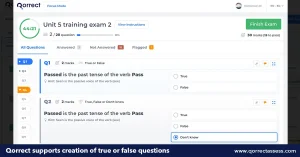
Qorrect can help institutions organize the true or false question format within structured electronic assessments. Instead of relying on manual processes, educators can use a digital assessment environment to manage questions, conduct assessments, and review performance data. This can make the true or false question format more practical for universities and educational institutions that conduct assessments at scale.
read more about: Online Evaluation System for Students with Smart Assessment
Benefits of True or False Questions
The true or false question format offers many benefits when it is carefully designed and aligned with educational objectives. Its simplicity makes it particularly suitable for assessing factual knowledge and checking students’ understanding of key concepts.
One of the main benefits of the true or false question format is efficiency. Students can respond quickly, while professors can evaluate responses with minimal effort. This makes the format useful for short quizzes, knowledge checks, revision activities, and formative assessments.
- Quick and Efficient Assessment
The true or false question format allows professors to evaluate a large number of concepts within a limited amount of time. Students do not need to write lengthy responses, which makes the assessment process faster.
- Simple and Accessible for Students
Another benefit of the true or false question format is its straightforward structure. Students do not need to interpret complicated response instructions, making the format accessible across different educational contexts.
- Easy and Objective Scoring
Because answers are limited to two options, the true or false question format can be scored consistently. Digital assessment platforms can further simplify this process by automating the evaluation of objective responses.
This is particularly useful for institutions managing large numbers of students, where manual grading can consume significant administrative time.
- Useful for Identifying Misconceptions
A carefully developed true or false question format can reveal whether students have misunderstood important concepts. Incorrect answers can indicate topics that require clarification, revision, or additional learning activities.
- Supports Digital and Large-Scale Assessment
The true or false question format is highly compatible with electronic assessment environments. Its objective nature makes it suitable for automated scoring and large-scale testing.
Qorrect can enhance the use of the true or false question format by providing a structured environment for creating and managing electronic assessments. By reviewing assessment results and performance data, educators can gain a clearer understanding of how students are responding to key concepts.
- Saves Time for Professors
The true or false question format can reduce the time required for grading compared with open-ended responses. When integrated into a digital assessment platform, this advantage becomes even more significant.
Qorrect can support this process by helping professors manage assessments digitally and streamline the evaluation of objective responses. This allows instructors to spend more time analyzing learning results and improving instructional strategies rather than performing repetitive grading tasks.
- Supports Formative Assessment
The true or false question format is also effective for formative assessment because it allows professors to conduct short knowledge checks throughout a course.
By combining the true or false question format with Qorrect’s digital assessment capabilities, educational institutions can create a more organized approach to continuous assessment and use assessment data to support better learning outcomes.
Best Practices for Using True or False Questions
To maximize the effectiveness of the true or false question format, professors should focus on question quality rather than simply increasing the number of questions.
When these practices are combined with a digital assessment solution in Qorrect platform, the true or false question format can become a practical component of a broader assessment strategy that supports efficient testing, consistent evaluation, and data-informed educational decisions.
read more about: Effective Formative Assessment Strategies for Universities
Tips for Writing True or False Questions
Creating an effective true or false question format requires more than simply writing a statement and adding two answer choices. The quality of the statement directly affects the reliability of the assessment and determines if the question measures actual knowledge or simply encourages guessing.
When professors design the true or false question format, they should make sure that every statement is directly connected to the learning objectives and reflects the concepts students are expected to understand. Clear wording, factual accuracy, and appropriate difficulty are essential for producing meaningful assessment results.
-
Write Clear and Specific Statements
A clear statement is one of the most important elements of an effective true or false question format. Students should immediately understand what the statement is asking without having to interpret complicated language.
A clear statement helps ensure that students’ answers reflect their knowledge rather than their ability to interpret confusing wording.
-
Avoid Ambiguous Wording
Ambiguous statements can reduce the reliability of the true or false question format because students may interpret the same statement differently. Words such as “usually,” “often,” “some,” or “generally” may create uncertainty when they are not clearly defined.
-
Focus on One Idea per Question
An effective true or false question format should normally focus on a single concept. Combining multiple ideas in one statement can make the question difficult to evaluate because one part of the statement may be correct while another part is incorrect.
-
Use Accurate and Verifiable Statements
Accuracy is essential when developing a true or false question format. Every statement should be supported by reliable course material, academic references, or established knowledge.
read more about: How Secure Online Assessment Improves Digital Exams
Types of True or False Questions
The true or false question format can be adapted to different educational objectives. By varying the structure of questions, professors can assess different aspects of students’ understanding while maintaining the straightforward true-or-false response model.
Different forms of the true or false question format can be selected according to the subject, students’ academic level, and intended learning outcomes.
-
Standard True or False Questions
Standard questions are the most familiar form of the true or false question format. Students receive a direct factual statement and determine whether it is correct.
Standard questions are especially suitable for short quizzes and formative assessments where professors need quick evidence of students’ understanding.
-
Statement-Based Questions
Statement-based questions use a specific claim related to the course content and ask students to evaluate its accuracy. This version of the true or false question format can be useful when professors want to assess whether students can distinguish accurate information from misconceptions.
-
Scenario-Based True or False Questions
Scenario-based questions introduce a short situation before asking students to determine whether a statement about that situation is true or false. This variation makes the true or false question format more contextual and can help professors assess how students apply knowledge.
By placing knowledge within a realistic context, professors can make the assessment more relevant to practical situations.
-
True or False Questions with Explanations
Adding explanations can make the true or false question format more valuable as a learning activity. Instead of simply identifying whether an answer is correct, students can be asked to explain their reasoning or review an explanation after submitting their response.
Combining different forms of the true or false question format can also help universities create more varied assessments and avoid relying on a single question structure.
Digital assessment platforms can make the process of creating and managing the true or false question format more efficient for professors and institutions. Qorrect provides a centralized environment for electronic assessment, allowing professors to organize objective questions as part of structured digital exams and quizzes.
Through Qorrect platform, the true or false question format can be incorporated into broader assessment strategies rather than being managed as isolated questions. This can help professors organize assessments more consistently and make it easier to evaluate student responses.
read more about: Academic Performance Measurement for Continuous Improvement
How Does Qorrect Support True or False Question Creation?
The value of Qorrect as an Online Assessment Platform is not limited to creating the true or false question format. Its role extends to supporting a broader digital assessment process in which question creation, exam delivery, evaluation, and analysis are connected.
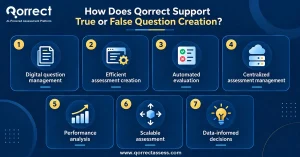
Qorrect can help streamline the use of the true or false question format through capabilities such as:
- Digital question management: Professors can organize objective questions within structured assessments.
- Efficient assessment creation: Questions can be incorporated into electronic quizzes and examinations.
- Automated evaluation: Objective responses can be evaluated efficiently, reducing repetitive manual grading.
- Centralized assessment management: Institutions can manage assessments within a more organized digital environment.
- Performance analysis: Assessment results can provide useful information about student performance and areas that may require additional support.
- Scalable assessment: Digital assessments can be used across different courses, classes, and student groups.
- Data-informed decisions: Educators can use assessment results to identify learning gaps and improve instructional strategies.
For universities and educational institutions, this approach can reduce administrative effort while providing professors with more opportunities to focus on interpreting assessment results and improving learning outcomes.
By integrating the true or false question format into a wider digital assessment strategy, Qorrect can help institutions move beyond traditional paper-based testing toward a more organized and data-informed approach to assessment.
Don’t miss the chance to be part of Qorrect’s educational community.
Contact Now with Qorrect Platform Experts,
FAQs
1- What Are Examples of True or False Questions?
Examples of the true or false question format include statements that ask students to determine whether a specific fact, definition, principle, or concept is correct.
For example:
- True or False: Photosynthesis allows plants to convert light energy into chemical energy.
- True or False: The Earth revolves around the Moon.
- True or False: A triangle has three sides.
- True or False: Effective communication requires both sending and receiving information.
The true or false question format can also be adapted to more advanced subjects by using scenarios or statements that require students to apply their knowledge.
2- How Do I Write Good True/False Questions?
To create an effective true or false question format, educators should write statements that are clear, accurate, specific, and directly aligned with the intended learning objectives. Each question should focus on one main idea and have a clearly verifiable answer.
Good practices include:
- Use clear and straightforward language.
- Focus on one idea per question.
- Avoid ambiguous or misleading statements.
- Avoid unnecessary negative wording.
- Ensure every statement is factually accurate.
- Avoid giving clues to the correct answer.
- Align questions with specific learning objectives.
- Review questions before adding them to an assessment.