 Qorrect Blog

Choosing the right exam types of questions can make a significant difference in how effectively professors measure student understanding, especially in higher education. Different questions can assess knowledge, critical thinking, problem-solving, and the ability to apply concepts in practical situations. Understanding exam types of questions also helps professors create balanced assessments that align with learning objectives and course content.
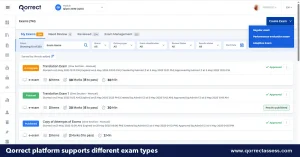
Qorrect platform supports the assessment process by providing a structured platform for creating, delivering, and analyzing assessments. Using Qorrect, professors can manage exam types of questions digitally and gain insights into student performance.
Move from manually managed assessments toward a more organized digital assessment workflow.
Book a free demo from Qorrect platform
Table of Contents
What Are the Different Exam Types of Questions Assessment?
Professors can use different exam types of questions to measure different aspects of student learning. A well-designed assessment usually combines several formats rather than depending on one question style. The choice should reflect the learning objectives, subject, course level, and skills students are expected to demonstrate.
Common exam types of questions include:
- Multiple-choice questions: Useful for assessing factual knowledge, concepts, and the ability to distinguish between possible answers.
- True or false questions: Suitable for checking students’ understanding of basic facts, principles, and statements.
- Short-answer questions: Allow students to provide concise responses and demonstrate their understanding without relying on answer choices.
- Essay questions: Help professors evaluate deeper understanding, reasoning, argumentation, and students’ ability to organize ideas.
- Matching questions: Effective for connecting related concepts, definitions, terms, or examples.
- Problem-solving questions: Particularly valuable in subjects such as mathematics, science, engineering, business, and other fields that require practical application.
Using different exam types of questions gives professors greater flexibility when designing assessments and can provide a broader picture of student achievement.
Qorrect platform helps professors manage different exam types of questions within a structured digital assessment environment. Instead of handling questions manually across separate files and processes, professors can organize their assessments digitally and use assessment data to better understand student performance.
read more about: What is an online proctored exam? Benefits and Types
How Do Different Exam Question Types Assess Student Learning?
Different exam types of questions measure different levels of learning. Multiple-choice questions can quickly assess knowledge and conceptual understanding, while essay questions provide more opportunities for students to explain their reasoning. Scenario-based questions can go further by asking students to apply knowledge to situations that resemble real academic or professional challenges.
The appropriate exam types of questions can help professors evaluate:
- Knowledge retention: Whether students remember important concepts, definitions, facts, and principles.
- Conceptual understanding: Whether students can explain ideas and recognize relationships between concepts.
- Application: Whether students can use their knowledge to solve problems or address practical situations.
- Critical thinking: Whether students can analyze information, compare alternatives, and reach logical conclusions.
- Communication skills: Whether students can clearly organize and present their ideas.
- Problem-solving abilities: Whether students can apply concepts to unfamiliar or complex problems.
With Qorrect platform, professors can benefit from, creating and organizing different question formats within digital assessments, building structured question banks for repeated or future assessments, managing questions according to courses, subjects, or assessment requirements, delivering electronic exams to students through a centralized platform, supporting automated evaluation for suitable question formats, managing grades and assessment results more efficiently, reviewing performance data to identify areas where students may need additional support, using assessment insights to improve future exam design.
This makes exam types of questions more than simply a choice of format, they become part of a broader assessment strategy focused on measuring learning outcomes effectively.
read more about: Generate Exam Questions with AI for Higher Education
How Do You Choose the Right Type of Exam Question?
Selecting the appropriate exam types of questions requires professors to consider what they actually want students to demonstrate. A question format should serve the learning objective. Before choosing among different formats, professors should consider:
Learning objectives: Determine whether the objective focuses on remembering, understanding, applying, analyzing, evaluating, or creating.
- Course content: Some subjects naturally require calculations, explanations, practical scenarios, or written arguments.
- Student level: The complexity of the questions should correspond to students’ academic level and prior knowledge.
- Assessment purpose: Formative assessments may require quick questions for feedback, while final exams may require a broader combination of formats.
- Available time: Consider how much time students need to answer each question and how long professors need to evaluate responses.
- Class size: Large classes may benefit from formats that can be evaluated efficiently, while smaller groups may allow more open-ended responses.
- Required skills: Choose formats that allow students to demonstrate the specific skills the course is intended to develop.
A balanced assessment question types may combine several types of questions to measure both foundational knowledge and higher-order thinking.
read more about: True or False Question Format for Effective Assessment
What Are the Advantages and Limitations of Different Exam Question Types?
Each of the exam types of questions has its own strengths and limitations. Understanding these differences allows professors to create assessments that are more balanced, reliable, and aligned with their educational goals.
| Question Type | Advantages | Limitations |
| Multiple-choice | Easy to organize and evaluate, suitablefor large groups | may not always reveal detailed reasoning |
| True or false | Quick to answer and useful for checking basic understanding | Limited ability to measure complex thinking |
| short answer | Allows student to explain concepts briefly | May require more manual evaluation |
| Essay | Measures reasoning, analysis, and written communication | Can take Significant time to grade |
| Matching | Efficient for testing relationships between concepts | Less suitable for advanced reasoning |
| Scenario- based | Measuring application and decision-making | Requires careful question design |
| Problem- solving | Evaluates practical application reasoning | Can require more time to complete and assess |
For this reason, professors should avoid relying exclusively on one format. Combining appropriate exam types of questions can create a more comprehensive assessment and give professors a clearer understanding of what students know.
Qorrect platform can further support this approach by providing professors with a digital environment for organizing questions, delivering assessments, managing results, and analyzing student performance. This allows professors to review how students perform across different exam types of questions and use the resulting insights to improve future assessments.
read more about: Online Evaluation System for Students with Smart Assessment
How Do Question Banks Support Different Types of Exam Questions?
Question banks give professors a structured way to organize, store, and reuse exam types of questions across different courses and assessments. Instead of creating every assessment from the beginning, professors can maintain a well-organized collection of questions categorized according to subject, topic, difficulty level, learning objective, and question format.
A strong question bank can make exam types of questions easier to manage while also helping professors create more balanced assessments. For example, an instructor may keep separate groups of multiple-choice, true or false, short-answer, essay, scenario-based, and problem-solving questions.
Question banks can support professors by allowing them to:
- Organize exam types of questions according to course topics and learning objectives.
- Categorize questions by difficulty level.
- Store questions for future assessments.
- Reduce repetitive work when preparing new exams.
- Create different versions of an assessment.
- Maintain a consistent standard across multiple exams.
- Select questions that measure different cognitive skills.
- Review and update questions when course content changes.
- Build assessments that combine different formats.
The use of question banks also makes it easier to create an exam question that matches a specific learning objective rather than selecting questions randomly.
Qorrect platform provides educational institutions with a digital environment for managing question banks and organizing exam types of questions more efficiently.
With Qorrect, educators can build and organize digital question banks, categorize questions based on relevant assessment requirements, access questions when preparing new electronic exams, manage large collections of questions more efficiently, create structured assessments from stored questions, support different formats within the same assessment, review student performance after an assessment, and use assessment data to inform future question development.
read more about: Effective Formative Assessment Strategies for Universities
How Does AI Support the Creation and Improvement of Different Types of Exam Questions?
Managing exam types of questions becomes more challenging as educational institutions increase the number of courses, students, instructors, and assessments. Manual processes can make it difficult to maintain consistency, organize question resources, monitor results, and identify areas for improvement.
Qorrect is an online assessment platform that helps educational institutions establish a more structured approach to digital assessment management. The platform supports question organization, exam creation, digital delivery, evaluation, and performance analysis within one centralized assessment environment, helping professors manage assessments more efficiently and gain valuable insights into student performance.
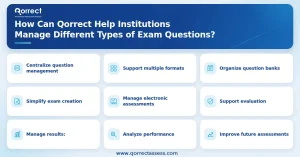
Educational institutions can use Qorrect to:
- Centralize question management: Keep assessment questions organized within a digital environment.
- Support multiple formats: Create assessments using different exam types of questions according to course requirements.
- Organize question banks: Structure questions so educators can locate and reuse appropriate content.
- Simplify exam creation: Help professors build assessments without managing separate manual files.
- Manage electronic assessments: Deliver exams digitally to students.
- Support evaluation: Automate the evaluation of suitable objective questions.
- Manage results: Keep assessment results organized for further review.
- Analyze performance: Provide useful assessment data that can help educators understand student achievement.
- Improve future assessments: Use performance insights to identify questions or topics that may need revision.
Qorrect can also help institutions establish greater consistency in assessment practices. When exam types of questions are organized within a centralized digital process, professors can make more informed decisions about question selection, assessment design, and student performance.
Effective assessment is not simply about having a large number of questions. It is about selecting the right formats for the intended learning outcomes. By combining well-designed question banks, responsible use of AI, educational institutions can make exam types of questions easier to create, manage, deliver, and improve.
Don’t miss the chance to be part of Qorrect’s educational community.
Contact Now with Qorrect Platform Experts,
FAQs
1- How can institutions ensure consistency across different exam versions?
Institutions can improve consistency by using standardized learning objectives, clear assessment guidelines, structured question banks, and defined difficulty levels when preparing exam types of questions. Questions should be reviewed regularly to ensure that different exam versions measure comparable knowledge and skills.
2- How many question types should an exam include?
There is no fixed number of exam types of questions that every exam should include. The appropriate number depends on the course objectives, subject matter, student level, exam duration, and skills the professor wants to measure.
A balanced assessment may combine several formats, such as multiple-choice, true or false, short-answer, scenario-based, or essay questions. Using a variety of exam types of questions can help professors assess both foundational knowledge and higher-order skills.