 Qorrect Blog

In modern education, formative assessment tools help professors understand student progress while learning is still taking place. Professors can use these tools to identify knowledge gaps, provide timely feedback, and adjust their teaching approaches. Effective formative assessment methods can also encourage students to become more aware of their strengths and areas for improvement.
Qorrect platform makes this process more organized by helping professors create, manage, and analyze electronic assessments. By using Qorrect platform, educational institutions can integrate formative assessment strategies into their learning processes, monitor performance, and use assessment data to support better learning outcomes.
Support your formative assessment tools with Qorrect
Book a free demo from Qorrect platform
Table of Contents
What Are Formative Assessment Tools?
Formative assessment tools are methods and digital resources that professors use to check student understanding during the learning process. Their purpose is not simply to assign grades, but to provide useful information that helps professors understand what students have learned, where they are struggling, and what areas require additional explanation.
Qorrect platform can help professors incorporate formative assessment tools into a structured digital assessment process. Instead of relying entirely on paper-based activities or separate systems, professors can use a centralized platform to create assessments and review student performance.
This makes formative assessment tools a practical part of continuous learning rather than a separate activity performed only before examinations.
What are the Benefits of Using Formative Assessment Tools in Higher Education?
Higher education involves complex subjects and diverse student needs, making it important for professors to monitor learning throughout the academic term. Formative assessment tools provide professors with regular opportunities to check whether students are keeping up with course content.
One of the most important benefits is the ability to identify learning gaps early. When professors discover that students are struggling with a particular concept, they can provide additional explanations, examples, exercises, or learning resources before moving to more advanced material.
Other side of benefits of formative assessment tools include:
- Immediate insight into student understanding.
- Early identification of learning gaps.
- Timely feedback from professors to their students.
- Better student engagement and interaction.
- Improved teaching decisions.
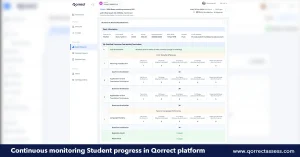
- Continuous monitoring of students’ progress.
- Greater student awareness of areas of weakness.
- Better alignment with learning objectives.
When implemented consistently, formative assessment tools can create a continuous feedback loop between teaching and learning.
Qorrect can strengthen this process by giving institutions a structured digital environment for creating assessments, collecting responses, organizing results, and reviewing student performance. This allows professors to move beyond simply collecting answers and use assessment information to make more informed academic decisions.
read more about: Exam Types of Questions – A Professor’s Guide to Assessments
What Are the Different Types of Formative Assessment Tools?
There is no single tool that works equally well for every subject or learning objective. Professors can select different formative assessment tools depending on the type of knowledge or skill they want to evaluate.
-
Online Quizzes
Online quizzes are among the most practical formative assessment tools for checking students’ understanding after a lecture, lesson, or specific topic. They can contain multiple-choice, true-or-false, matching, or short-answer questions.
-
Short-Answer Activities
Short-answer activities give students an opportunity to explain an idea in their own words. They can reveal misunderstandings that may not be visible through selected-response questions.
-
Peer Feedback
Peer feedback allows students to review and comment on each other’s work. This can encourage critical thinking while helping learners recognize different approaches to the same task.
-
Self-Assessment
Self-assessment encourages students to evaluate their own understanding and identify areas where they need additional practice.
-
Practice Questions
Practice questions provide students with opportunities to apply recently learned concepts without the pressure of a high-stakes examination.
Qorrect can help professors organize several formative assessment tools within a digital assessment workflow. Professors can create question banks, develop electronic quizzes, deliver assessments, and review results to understand how students are progressing.
Qorrect platform can also help institutions maintain organized assessment data, making it easier to identify patterns in student performance and use those insights to improve learning activities.
read more about: What is an online proctored exam? Benefits and Types
How Do Formative Assessment Tools Measure Learning Outcomes?
Effective formative assessment tools should be connected to clearly defined learning outcomes. The goal is not simply to give students more questions, but to collect meaningful evidence about whether they are developing the knowledge and skills expected from the course. Formative assessment tools can help professors measure learning outcomes by:
- Connecting questions to specific learning objectives.
- Checking students’ understanding of key concepts.
- Measuring the ability to apply knowledge.
- Identifying misconceptions and knowledge gaps.
- Monitoring progress throughout the course.
- Providing evidence of student development.
- Supporting timely academic intervention.
- Helping professors determine whether teaching approaches are effective.
Qorrect can support the use of formative assessment tools by bringing assessment creation, digital delivery, results management, and performance analysis into a structured environment. Professors can use Qorrect platform to:
- Create questions related to specific learning objectives.
- Organize questions within digital question banks.
- Deliver assessments electronically.
- Review student responses and results.
- Identify areas of strong and weak performance.
- Use assessment data to support instructional decisions.
- Monitor learning progress over multiple assessment activities.
When formative assessment tools are connected to learning outcomes and supported by meaningful assessment data, they can provide professors with a clearer picture of student progress. This allows professors to respond to learning needs during the course rather than waiting until final examination results reveal a problem.
read more about: Generate Exam Questions with AI for Higher Education
How Can Educators Choose the Right Formative Assessment Tool?
Choosing the right formative assessment tools depends on what professors want to learn about their students. A tool that works well for checking factual knowledge may not be suitable for evaluating critical thinking, problem-solving, or the ability to apply concepts in real situations.
Educators should begin by identifying the learning objective and then select formative assessment tools that can provide meaningful evidence of student understanding. The assessment should also fit the course content, student level, available time, and teaching environment.
When selecting formative assessment tools, educators should consider:
- Learning objectives: Choose a tool that measures the knowledge or skill students are expected to develop.
- Type of learning: Determine whether students need to demonstrate recall, understanding, application, analysis, or problem-solving.
- Student level: Make sure the complexity of the activity is appropriate for the learners.
- Course content: Select questions and activities that reflect the material actually taught.
- Feedback requirements: Consider how quickly students need feedback to improve their performance.
- Class size: Large classes may require digital tools that can manage responses efficiently.
- Ease of use: Both educators and students should be able to use the assessment process without unnecessary complexity.
- Data availability: The tool should provide useful information that educators can use to make teaching decisions.
A well-designed formative assessment tool should therefore be selected based on its educational purpose rather than simply its technological features.
Qorrect platform can give educators a structured digital environment for creating and managing different formative assessment tools. By organizing assessment activities digitally, professors can focus more on interpreting student performance and responding to learning needs.
Qorrect can help educators:
- Create digital assessments according to course requirements.
- Organize questions by topic and learning objective.
- Select appropriate question formats for different learning goals.
- Deliver assessments electronically.
- Review student responses and results.
- Identify areas where additional instruction may be needed.
- Use assessment data to improve future activities.
read more about: True or False Question Format for Effective Assessment
How Do Question Banks Support Formative Assessment?
Question banks can make formative assessment tools easier to organize and reuse. Instead of creating every assessment from the beginning, professors can maintain a structured collection of questions that can be selected according to topic, difficulty, learning objective, or question format.
A well-designed question bank also allows professors to create multiple learning activities throughout the semester without repeatedly preparing the same content. Questions can be reviewed, updated, and reused when appropriate.
Question banks support professors by allowing them to:
- Store questions in one organized digital location.
- Categorize questions according to course topics.
- Organize questions by difficulty level.
- Connect questions with specific learning objectives.
- Create different assessments from existing questions.
- Reuse suitable questions for practice activities.
- Update outdated questions when course content changes.
- Develop a wider variety of assessment activities.
- Reduce repetitive preparation work.
A professor teaching a large introductory course may create a question bank containing questions about every major topic. During the semester, the professor can select different questions to create short activities that check understanding after individual lessons.
This makes formative assessment tools more flexible because professors can continuously evaluate learning without having to design an entirely new assessment each time.
Qorrect can support a question bank supported by AI in generating Questions and giving institutions a structured environment for organizing assessment questions. Professors can use organized question resources to create digital assessments and review student performance over time.
By combining organized question banks with digital assessment capabilities, institutions can make formative assessment tools a regular part of the learning process rather than an occasional activity.
read more about: Online Evaluation System for Students with Smart Assessment
How Can Qorrect Support Formative Assessment in Higher Education?
Higher education institutions often manage large numbers of students, courses, instructors, and assessments. Without a structured system, managing formative assessment tools across different academic departments can become time-consuming and difficult to standardize.
Qorrect, an Online Assessment Platform, helps institutions create a more organized digital assessment workflow. The platform supports professors in creating assessments, managing questions, delivering electronic assessments, and reviewing performance data, making it easier to monitor student progress and improve learning outcomes.
Qorrect can support higher education institutions by providing:
- Digital assessment creation: Professors can create electronic assessments for different courses and learning activities.
- Question bank management: Educational Institutions can organize and maintain collections of assessment questions.
- Multiple question formats: Professors can select formats appropriate for different learning objectives.
- Centralized assessment management: Assessment activities can be managed within a structured digital environment.
- Automated evaluation: Suitable objective questions can be evaluated automatically, reducing repetitive grading work.
- Performance analysis: Professors can review assessment results to understand student performance.
- Data-driven decisions: Assessment information can help professors identify learning gaps and determine where additional support may be needed.
- Continuous monitoring: Regular digital assessments allow professors to follow student progress throughout the academic term.
- Improved assessment organization: Digital workflows can reduce dependence on scattered files and manual processes.

The value of formative assessment tools increases when the information they produce is actually used to improve teaching and learning. Qorrect can help professors move through this process in a structured way. This creates a continuous feedback cycle between assessment and instruction.
Instead of handling assessment as an endpoint, educational institutions can use formative assessment tools as part of an ongoing approach to improving student learning.
Qorrect platform can therefore serve as a practical digital environment for organizing assessments, managing questions, reviewing results, and turning assessment data into useful academic insights.
Don’t miss the chance to be part of Qorrect’s educational community.
Contact Now with Qorrect Platform Experts,
FAQs
1- What are the 5 formative assessment strategies?
Five widely used strategies can help professors monitor student understanding and respond to learning needs during a course:
- Questioning: Asking targeted questions during a lesson to determine whether students understand the concept.
- Classroom discussions: Encouraging students to explain their ideas and learn from different perspectives.
- Feedback: Providing timely and specific comments that help students recognize what they are doing well and what they need to improve.
- Self-assessment: Encouraging students to evaluate their own understanding and identify areas that require additional practice.
- Peer assessment: Allowing students to review and provide constructive feedback on each other’s work.
These approaches can be supported by digital formative assessment tools, which make it easier for professors to collect responses, monitor progress, and identify learning gaps.
2- What are some techniques for formative assessment?
There are many techniques professors can use to check student understanding without waiting for a final examination. The most appropriate approach depends on the course objectives, student level, and type of learning being evaluated.
Common techniques include short online quizzes, polls and quick classroom questions, one-minute responses, exit tickets, practice exercises, short-answer activities, peer feedback, self-assessment, classroom discussions, and reflection activities.