 Qorrect Blog

In higher education institutions, student performance assessment helps universities understand how effectively learners are progressing toward academic goals. It gives professors valuable insights into students’ knowledge, skills, strengths, and areas that need improvement throughout their academic journey. Effective student performance evaluation should go beyond final grades by using reliable evidence from different learning activities and assessments.
By using Qorrect platform, institutions can monitor student progress, review assessment results, identify learning gaps, and use meaningful data to support better teaching decisions and improved learning outcomes.
Qorrect can make student performance assessment more organized,,
Book a free demo from Qorrect platform
Table of Contents
What Is Student Performance Assessment?
Student performance assessment is the process of collecting and analyzing evidence to understand how well students are achieving the knowledge, skills, and learning outcomes expected from a course or academic program. Student performance assessment can take place through examinations, assignments, projects, quizzes, practical activities, presentations, and other learning tasks.
Effective student performance assessment should not focus only on the final grade. It should give professors a broader understanding of how students learn, where they are progressing successfully, and which areas require additional support.
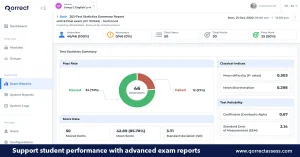
Qorrect platform can support universities by providing a digital environment for managing student performance assessment. Professors can use Qorrect platform to create electronic assessments, organize questions, deliver exams, and review assessment results.
This allows student performance assessment to become part of an ongoing academic process rather than something that happens only at the end of a semester.
read more about: Formative Assessment Tools – Types, Uses, and Benefits
Why Is Student Performance Assessment Important in Higher Education?
Universities need reliable ways to determine whether students are achieving their intended learning outcomes. Student performance assessment provides professors with evidence that can be used to evaluate academic progress and improve the learning experience.
When assessment is conducted regularly, professors can identify difficulties before they become significant barriers to student success. Instead of discovering that students have struggled only after a final examination, professors can use assessment results throughout the course to adjust instruction and provide additional support.
The importance of student performance assessment can be seen in the following points:
- Measuring learning outcomes: It helps determine whether students have achieved the knowledge and skills defined by the course.
- Identifying learning gaps: Results can reveal topics that require additional explanation or practice.
- Providing feedback: Students can understand where they are performing well and where improvement is needed.
- Supporting academic decisions: Professors can use assessment information when planning instruction and support activities.
- Improving teaching quality: Performance data can help professors evaluate whether their teaching approaches are producing the expected results.
- Encouraging student engagement: Regular assessment gives students more opportunities to monitor their own progress.
- Supporting institutional improvement: Aggregated assessment information can contribute to broader academic quality initiatives.
Another important advantage is that student performance assessment can provide a more complete picture when institutions use multiple forms of evidence rather than depending on a single examination.
Qorrect can support student performance assessment by helping institutions organize assessments digitally and review results in a structured way. By making performance information easier to access and analyze, professors can focus on using evidence to improve teaching and learning.
read more about: Exam Types of Questions – A Professor’s Guide to Assessments
What Are the Key Methods of Student Performance Assessment?
Effective student performance assessment usually combines different approaches according to the learning objectives, subject area, academic level, and skills students are expected to demonstrate.
There is no single method that can measure every aspect of learning. There are common methods used include:
-
Examinations and Quizzes
Examinations and quizzes are widely used to measure students’ understanding of concepts, facts, theories, and principles. Digital assessments can make it easier to deliver questions and organize results.
-
Assignments
Assignments allow students to demonstrate their understanding through written responses, research, analysis, or practical tasks. They can provide evidence of how students apply concepts beyond a traditional examination.
-
Projects
Projects can measure research, collaboration, problem-solving, creativity, and practical application. They are particularly useful when learning outcomes require students to work on complex tasks.
-
Presentations
Presentations can help professors evaluate students’ communication skills, understanding of a subject, ability to organize information, and confidence in explaining concepts.
-
Practical Assessments
Practical activities are valuable in disciplines where students need to demonstrate specific procedures or technical skills. These assessments can show whether students can apply theoretical knowledge in realistic situations.
-
Online and Digital Assessments
Digital assessments can provide an efficient way to collect responses and organize results, particularly when institutions manage large numbers of students.
Using several methods can make student performance assessment more comprehensive because each method provides a different type of evidence.
Qorrect can contribute to the digital side of student performance assessment by helping institutions create and manage electronic assessments, organize question banks, evaluate suitable objective questions, and review performance results.
raed more about: What is an online proctored exam? Benefits and Types
What Factors Should Be Considered When Assessing Student Performance?
For student performance assessment to provide meaningful results, professors need to consider several factors before designing and delivering an assessment. A well-written test does not guarantee that the results accurately represent student learning.
Professors should consider:
- Learning objectives: Every assessment should be connected to what students are expected to know or do.
- Assessment validity: Questions and activities should measure the intended knowledge or skills.
- Reliability: Assessment procedures should produce consistent results when appropriate.
- Difficulty level: Questions should reflect the academic level of the students and the intended learning outcomes.
- Question variety: Using different formats can provide a broader picture of student understanding.
- Fairness: Assessment requirements should give students an appropriate opportunity to demonstrate their learning.
- Feedback: Students should receive useful information that can guide future improvement.
- Timing: Assessments should be scheduled at appropriate points during the learning process.
- Data quality: Results should be interpreted carefully rather than relying on a single score.
- Student context: Professors should consider relevant learning conditions when interpreting performance results.
These factors can make student performance assessment more accurate and useful for both students and educators. Qorrect platform can help institutions manage several parts of the assessment process within a digital environment. By organizing questions, assessments, results, and performance information, Qorrect can support a more consistent approach to student performance assessment.
read more about: Generate Exam Questions with AI for Higher Education
How Do Digital Assessment Platforms Automate Grading and Scoring?
Automated grading is one of the most valuable advantages of digital assessment platforms in higher education. Instead of evaluating every answer manually, professors can use digital tools to score objective questions automatically, calculate final grades, and organize assessment results in a structured format. This makes student performance assessment more efficient by reducing repetitive administrative tasks and allowing professors to focus on understanding students’ learning needs.
Digital assessment platforms can also help maintain consistency in grading by applying predefined scoring rules across all submissions.
Automated grading can support student performance assessment in several ways:
- Faster results: Students can receive their scores more quickly, allowing them to understand their performance without unnecessary delays.
- Consistent scoring: Predefined grading rules help ensure that similar responses receive the same scores.
- Reduced administrative workload: Instructors can spend less time calculating grades and more time supporting students.
- Better performance tracking: Organized scoring data helps professors identify students who may need additional guidance.
- More informed teaching decisions: Assessment results can reveal topics that require further explanation or additional practice.
With Qorrect platform, institutions can organize digital assessments and benefit from structured grading and assessment results. This helps professors manage evaluation processes more efficiently and use the available data to strengthen student performance assessment across courses and academic programs.
read more about: True or False Question Format for Effective Assessment
How Do Question Banks Improve Digital Assessment?
Question banks help universities organize assessment questions in a centralized, reusable format. Instead of creating every exam from scratch, professors can build a collection of questions aligned with course content, learning objectives, and different levels of difficulty. This approach makes student performance assessment more flexible while helping institutions maintain consistency across multiple assessments.
Question banks can improve digital assessment in several important ways:
- Question organization: Professors can categorize questions by subject, topic, difficulty level, or learning objective.
- Assessment variety: A diverse question collection allows professors to evaluate knowledge, comprehension, application, and critical thinking.
- Greater efficiency: Reusing and updating existing questions reduces the time required to prepare new exams.
- Consistent assessment standards: Structured question collections help instructors align exams with course objectives.
- More comprehensive evaluation: Questions covering different topics provide a broader view of students’ strengths and knowledge gaps.
Question banks also contribute to more effective student performance assessment by giving professors greater flexibility in designing tests that measure different learning outcomes.
Qorrect supports digital assessment management by helping institutions organize and manage questions for electronic exams. By using a structured approach to question management, professors can simplify exam preparation, develop assessments that align with their teaching objectives, and make better use of assessment results to guide academic decisions.
raed more about: Online Evaluation System for Students with Smart Assessment
How Can Assessment Analytics Help Improve Learning Outcomes?
Assessment analytics helps professors transform exam results into meaningful insights about student learning. Rather than relying only on final grades, universities can review patterns in students’ answers, compare results across assessments, and identify topics where learners consistently.
Assessment analytics can improve student performance assessment through several approaches:
- Identifying learning gaps: Results can highlight concepts that students have not fully understood.
- Monitoring progress: Comparing assessment results over time helps professors evaluate changes in academic performance.
- Supporting early intervention: Identifying repeated difficulties can help professors provide assistance before students fall further behind.
- Improving instructional strategies: Performance patterns can show when teaching materials or classroom activities need adjustment.
- Evaluating assessment effectiveness: Question-level results can help professors review whether questions are appropriate and aligned with learning objectives.
- Supporting data-informed decisions: Aggregated results can help academic leaders identify broader trends across courses or programs.
Effective student performance assessment depends on using data to guide meaningful action rather than simply collecting scores. Professors should interpret analytics alongside course objectives, assessment design, student progress, and relevant learning conditions. Qorrect can support this process by helping institutions manage digital assessments and review the resulting performance data.
What Security Features Should a Digital Assessment Platform Provide?
Security is a fundamental consideration when universities adopt digital assessment platforms. Institutions must protect examination content, student information, assessment results, and academic records from unauthorized access or misuse.
Important security features include:
- Secure user authentication: Verifying user identities helps restrict access to authorized students, professors, and administrators.
- Role-based access controls: Permissions help ensure that users can access only the information and functions relevant to their responsibilities.
- Data encryption: Appropriate encryption measures help protect sensitive information during transmission and storage.
- Secure question management: Access restrictions help prevent unauthorized viewing, copying, or modification of examination content.
- Controlled exam access: Configurable assessment settings can help institutions manage when and how students access examinations.
- Audit trails and activity records: Where available, these records help administrators review relevant actions and investigate potential irregularities.
- Data privacy and backup practices: Appropriate policies and technical safeguards help protect academic records and support data recovery when necessary.
Security should also be balanced with accessibility and usability. Complicated access procedures can create unnecessary difficulties for students, so institutions should choose solutions that protect assessment data without introducing avoidable barriers.
For effective student performance assessment, security measures should be supported by clear examination policies, appropriate staff training, and consistent procedures for handling assessment data. Qorrect platform can help institutions organize their digital assessment processes within a structured environment, supporting more controlled assessment management.
How Does a Digital Assessment Platform Support Academic Quality Assurance?
Academic quality assurance helps universities maintain educational standards, evaluate teaching effectiveness, and ensure that assessments accurately reflect intended learning outcomes. Digital assessment platforms can support these efforts by making assessment processes more organized, consistent, and easier to review. Through structured student performance assessment, institutions can gather evidence about student learning and use it to identify opportunities for academic improvement.
Digital assessment platforms can support academic quality assurance through the following practices:
- Aligning assessments with learning outcomes: Questions and assessment activities can be organized around defined course objectives.
- Standardizing assessment procedures: Consistent digital workflows help departments apply agreed-upon assessment practices.
- Maintaining organized records: Digital results make it easier to retrieve relevant assessment information for internal reviews.
- Supporting performance analysis: Assessment data can help educators evaluate student achievement and identify recurring knowledge gaps.
- Improving assessment design: Reviewing question-level performance can reveal questions that may need clarification or revision.
- Supporting continuous improvement: Results from one assessment cycle can inform changes to teaching methods and future examinations.
- Strengthening institutional reporting: Consolidated assessment information can help academic leaders review progress toward educational objectives.
Qorrect platform can contribute to these efforts by helping universities create, manage, deliver, and analyze electronic assessments within a structured digital environment. By organizing assessment information and making results easier to review, Qorrect can support evidence-informed decisions, help professors identify areas for improvement, and strengthen the role of student performance assessment in institutional quality assurance.
How Can Qorrect Help Institutions Manage Digital Assessments?
Managing digital assessments across a university involves several connected responsibilities, including preparing questions, creating exams, organizing student access, evaluating responses, and reviewing results.
As an Online Assessment Platform, Qorrect helps universities integrate these assessment activities into a more organized digital workflow, allowing professors to focus on the quality of their assessments and the insights they provide. This is particularly valuable for student performance assessment, where reliable results and meaningful analysis are essential for understanding learning progress and supporting academic development.
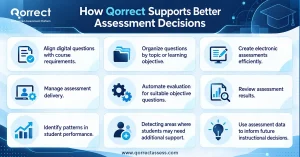
Qorrect can support institutional assessment workflows in several ways:
- Creating electronic assessments: Professors can prepare digital exams suited to their course objectives and evaluation requirements.
- Managing question banks: Organizing questions helps instructors reuse relevant content and prepare assessments more efficiently.
- Supporting different question formats: Using suitable question types allows professors to evaluate different aspects of student knowledge and understanding.
- Streamlining grading processes: Automated scoring for supported question types can reduce manual work and accelerate result processing.
- Organizing assessment results: Structured results help professors review student achievement and identify areas that require attention.
- Supporting assessment analytics: Reviewing available performance data can help professors recognize learning gaps and make informed teaching decisions.
- Improving assessment administration: A structured digital workflow can help institutions coordinate assessment activities and reduce repetitive administrative tasks.
Qorrect can also help institutions establish a more consistent approach to assessment management across courses and departments. When professors organize exams carefully, review results systematically, and connect findings with course learning objectives, digital assessment becomes more than a method of delivering tests. It becomes a practical source of evidence for improving teaching and learning.
Effective student performance assessment requires the right combination of well-designed questions, reliable scoring, meaningful data analysis, and appropriate academic follow-up.
Qorrect platform can support these efforts and enable professors to use assessment results to guide improvement, strengthen academic processes, and create better learning experiences for students.
Don’t miss the chance to be part of Qorrect’s educational community.
Contact Now with Qorrect Platform Experts,
FAQs
1- What indicators can be used to monitor student performance?
Several indicators can help professors monitor student progress and build a clearer picture through student performance assessment. No single indicator is sufficient on its own, so universities should consider multiple sources of evidence.
Important indicators include: assessment scores, assignment results, attendance and participation, progress over time, question-level results, learning out comes students are achieving the expected course objectives, feedback and responses.
Digital student performance assessment platforms can make these indicators easier to organize and review. Qorrect can help professors manage electronic assessments and analyze results, giving them useful information for monitoring academic progress.
2- How can assessment data identify students who need additional support?
Assessment data can help professors identify students who may be struggling by revealing patterns in their results. For example, consistently low scores, repeated mistakes on questions covering the same concept, or a decline in performance across multiple assessments may indicate that additional academic support is needed.
Effective student performance assessment allows professors to look beyond a single examination result and consider performance across multiple activities.
Professors can use assessment data to:
- Identify consistently low performance.
- Detect repeated errors or misconceptions.
- Monitor changes in results over time.
- Identify difficult topics or learning outcomes.
- Compare individual progress with expected course outcomes.
- Determine where additional explanations or practice may be useful.
- Provide targeted academic interventions.
3- What makes a student performance assessment reliable and valid?
A reliable and valid student performance assessment should consistently measure the knowledge, skills, or learning outcomes it is intended to measure. Reliability focuses on the consistency of assessment results, while validity considers whether the assessment actually measures the intended learning outcomes.
Several factors contribute to quality student performance assessment, including: Clear learning objectives, appropriate question design, balanced assessment formats, consistent assessment procedures, fair evaluation criteria, sufficient assessment evidence, and regular review.