 Qorrect Blog

In the evolving landscape of universities and educational institutions, digital assessment has become a major tool for measuring student performance, improving academic quality, and supporting decision-making. Unlike traditional assessment, digital assessment offers greater flexibility, faster feedback, and deeper insights into students’ performance.
Qorrect platform supports universities to take full advantage of digital assessment by providing a comprehensive environment for creating, managing, and analyzing assessments. Through features such as digital assessment delivery, automated grading, question banks, and learning outcomes analysis, qorrect empowers educational institutions to enhance the quality of assessment.
Enhance digital assessment for universities,
Book a free demo from Qorrect platform
Table of Contents
What Is Digital Assessment?
Digital assessment refers to the use of technology to create, deliver, manage, and evaluate student assessments. It includes a wide range of evaluation methods, from quizzes and assignments, all conducted through digital platforms.
Key characteristics of digital assessment include:
- Conducting assessments electronically rather than through paper-based methods.
- Supporting both in-person and remote learning environments.
- Automating grading and feedback processes where appropriate.
- Providing real-time access to results and performance data.
- Enhancing the efficiency and consistency of assessment management.
- Supporting outcome-based education and continuous improvement initiatives.
- Integrating with institutional learning management systems.
Qorrect platform helps universities implement effective digital assessment practices by offering a comprehensive platform for exam creation, assessment management, grading, analytics, and learning outcomes tracking.
read more about: The Future of Online Assessment Proctoring in Universities
Why Digital Assessment Is Transforming Higher Education
Universities are increasingly depending on digital assessment because it solves many of the problems related to traditional evaluation methods. As the number of students grows and learning models become more flexible, digital solutions provide the scalability and efficiency institutions need.
Reasons why digital assessment is transforming higher education include:
- Supporting online, hybrid, and campus-based learning models.
- Improving the speed and accuracy of assessment processes.
- Providing immediate access to assessment data and insights.
- Enhancing student engagement through interactive assessment formats.
- Supporting continuous evaluation rather than relying solely on final examinations.
- Reducing administrative workload and operational costs.
- Strengthening quality assurance and accreditation efforts.
Through advanced digital assessment capabilities, automated workflows, and performance analytics, Qorrect enables universities to modernize assessment processes while maintaining academic quality and integrity.
read more about: How Online Examination Systems Improve Universities
Key Benefits of Digital Assessment for Universities
Implementing digital assessment offers universities significant operational and educational advantages. Here are the key benefits of digital assessment for universities:
Faster Grading and Feedback
- Automates the grading of objective question types.
- Reduces turnaround time for exam results.
- Enables students to receive feedback more quickly.
- Helps faculty focus on teaching and academic development.
Improved Assessment Accuracy
- Minimizes manual grading errors.
- Standardizes evaluation processes across departments.
- Supports the use of digital rubrics and structured grading criteria.
- Enhances fairness and consistency in assessment outcomes.
Better Learning Analytics
- Provides detailed reports on student performance.
- Tracks trends across courses and academic programs.
- Supports evidence-based curriculum improvement.
- Helps educational institutions monitor achievement of learning outcomes.
Qorrect enhances digital assessment by combining automated grading, detailed analytics, and centralized assessment management, helping universities improve both efficiency and educational quality.
read more about: Online Proctored Exam Software and Secure Testing
Types of Digital Assessment
Universities use various forms of digital assessment to evaluate student learning across different educational aspects and to identify target needs in educational objectives. Here are the types of digital assessment:
Formative Assessment
- Conducted throughout the learning process.
- Provides continuous feedback to students and professors.
- Helps identify learning challenges before final evaluations.
- Supports continuous academic improvement.
Summative Assessment
- Measures student achievement at the end of a course or learning period.
- Includes final exams, projects, and major assignments.
- Evaluates overall attainment of learning outcomes.
- Supports grading and certification decisions.
Adaptive Assessment
- Adjusts question difficulty based on student responses.
- Provides a more personalized assessment experience.
- Improves measurement accuracy for different skill levels.
- Supports deeper insights into student capabilities.
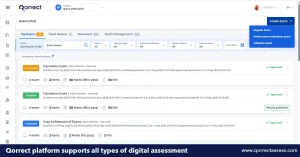
Qorrect supports multiple forms of e-assessment, enabling universities to design formative, summative, and adaptive assessments within a single integrated platform.
read more about: Smart Evaluation Systems for Modern Higher Education
The Importance of Question Banks in Digital Assessment
Question banks are a fundamental component of successful digital assessment strategies. They allow universities to build, organize, and manage large collections of assessment items efficiently.
Benefits of question banks in digital assessment include:
- Supporting the creation of diverse and balanced assessments.
- Reducing repetitive exam preparation tasks.
- Improving exam security through question randomization.
- Aligning questions with learning outcomes and course objectives.
- Maintaining consistency across departments and academic programs.
- Facilitating continuous improvement of assessment quality.
- Supporting large-scale assessment delivery.
Qorrect platform provides advanced question bank management tools that help universities organize, categorize, and align questions with learning outcomes, improving both assessment quality and efficiency.
How Learning Analytics Enhance Digital Assessment
Learning analytics significantly increases the value of digital assessment by transforming assessment results into actionable insights.
Student Performance Analysis
- Tracks achievement across courses and programs.
- Identifies strengths and weaknesses in student performance.
- Supports personalized academic support strategies.
- Enables more accurate evaluation of learning progress.
Identifying Learning Gaps
- Highlights areas where students struggle most.
- Helps faculty adjust teaching methods and course content.
- Supports targeted interventions to improve outcomes.
- Enhances the effectiveness of academic support services.
Data-Driven Decisions
- Provides evidence for curriculum development.
- Supports institutional planning and quality assurance initiatives.
- Improves assessment design and delivery.
- Strengthens continuous improvement processes.
Through advanced analytics dashboards, Qorrect platform helps universities maximize the value of digital assessment data by providing clear insights into student achievement, assessment effectiveness, and learning outcomes attainment.
read more about: Learning Outcomes Assessment in Universities
Digital Assessment and Academic Accreditation
Academic accreditation increasingly requires institutions to explain measurable learning outcomes, assessment quality, and continuous improvement. Digital assessment provides the documentation and evidence necessary to meet these expectations.
Ways digital assessment supports accreditation include:
- Providing transparent and traceable assessment processes.
- Generating reliable performance data for accreditation reports.
- Supporting outcomes-based education frameworks.
- Demonstrating achievement of institutional learning objectives.
- Maintaining consistent assessment standards across departments.
- Creating audit trails for assessment review and verification.
- Supporting evidence-based quality assurance initiatives.
Qorrect platform helps universities align digital assessment practices with accreditation requirements through comprehensive reporting, outcomes mapping, analytics, and centralized assessment management.
How Do Platforms Like Qorrect Enhance Digital University Assessment?
Modern universities require more than basic testing tools. Effective digital assessment depends on integrated platforms that combine assessment delivery, analytics, security, and learning outcomes measurement.
Qorrect platform enhances digital assessment by offering:
- Centralized management of assessments and .
- Automated grading and feedback capabilities.
- Advanced question bank management.
- Learning outcomes mapping and tracking.
- Detailed analytics and performance reporting.
- Secure online assessment delivery.
- Support for accreditation and quality assurance processes.
- Scalable assessment solutions for institutions of all sizes.
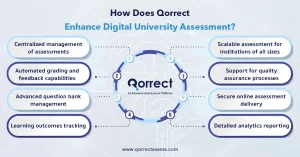
Qorrect helps universities overcome the challenges that face the assessment process in educational institutions by providing a user-friendly Online Assessment Platform with secure assessment tools, advanced analytics, seamless integration capabilities, question bank management, and dedicated support for learning outcomes assessment and academic quality initiatives.
As a comprehensive Online Assessment Platform, Qorrect enables universities to improve assessment quality, streamline assessment operations, support learning outcomes assessment, and make data-driven academic decisions that contribute to long-term institutional success.
Don’t miss the chance to be part of Qorrect’s educational community.
Contact Now with Qorrect Platform Experts,
FAQs
1- How does digital assessment support accreditation?
Digital assessment plays a crucial role in helping universities meet accreditation and quality assurance requirements by providing reliable evidence of student achievement and learning outcomes.
- Creates transparent and traceable assessment processes.
- Generates accurate data for accreditation reports and institutional reviews.
- Supports outcomes-based education by linking assessments to learning outcomes.
- Provides detailed analytics that demonstrate student achievement and program effectiveness.
- Maintains consistent assessment standards across courses and departments.
- Creates audit trails that can be reviewed during accreditation evaluations.
- Supports continuous improvement initiatives through data-driven insights.
2- What are the challenges of implementing digital assessment?
While digital assessment offers significant benefits, universities may face several challenges during implementation. Proper planning, training, and technology selection are essential for a successful transition.
Common challenges include:
- Adapting existing assessment processes to digital environments.
- Ensuring faculty and student readiness through training and support.
- Maintaining assessment security and academic integrity.
- Managing technical infrastructure and system reliability.
- Integrating assessment platforms with existing LMS and institutional systems.
- Developing high-quality question banks and assessment content.
- Ensuring compliance with data privacy and accessibility requirements.